The Map Moved. Most Developers Are Still Building on the Old One.
Contents
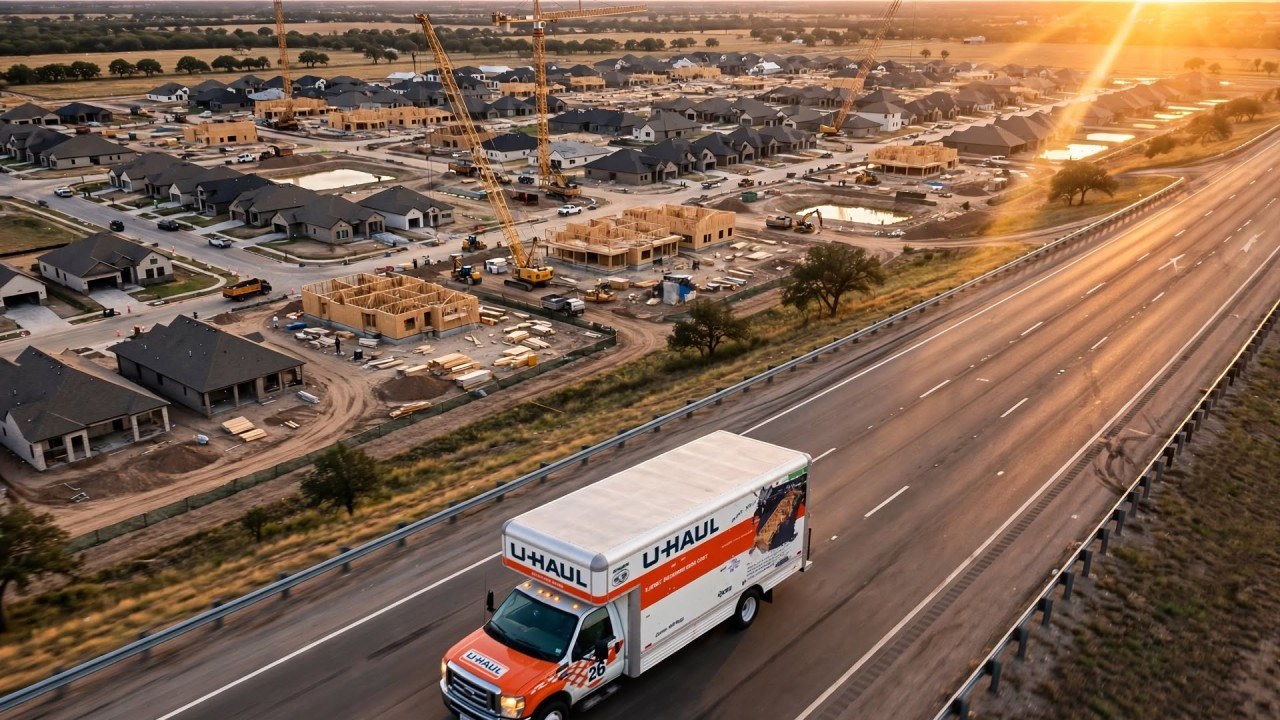
Somewhere on an interstate tonight, a family is following a 26-foot moving truck south. They aren't reading Census reports or cap-rate surveys. They're chasing something simpler: a better job, a bigger yard, a paycheck that stretches further. Multiply that one truck by hundreds of thousands, and you get the most powerful force in American real estate — and the most ignored.
Here's the number that stopped me cold: last year the South absorbed essentially all of America's net domestic migration, roughly 358,000 people, while the Northeast and West each lost about 200,000. Celina, Texas, a town north of Dallas, grew 24.6% in a single year, per Census Vintage 2025. Not a decade. A year.
So was the developer who bought land in Celina five years ago a genius? Or did they just refuse to argue with the moving trucks?
That's the whole thesis: it is easier to thrive when you follow population and industry. Development is hard everywhere, but a rising market forgives your mistakes and a flat one punishes your perfection. As an estimator, I'll tell you a secret — the same apartment building costs roughly the same to build in a shrinking metro as in a booming one. The concrete doesn't care. The demand on the other side of delivery is what makes or breaks the deal.
The map has moved
The 2025 Census estimates tell a clear story, and a more interesting one than the usual "everyone's moving to Austin" take. National population growth slowed to just 0.5%, the slowest since 2021, as international migration fell sharply. That makes domestic migration the cleanest signal we have of where Americans actually choose to live. And the signal is loud:
- South Carolina is now the fastest-growing state (1.5%), with the Carolinas pulling in movers at a pace that has them beating Texas and Florida on migration rate.
- Texas added more people than any state — roughly 391,000 residents in one year. Houston and Dallas–Fort Worth each absorbed a mid-sized city's worth of new neighbors.
- Charlotte gained more residents than any city in America (+20,731). Not New York. Not L.A. Charlotte.
- The growth isn't downtown — it's the outer ring. The five fastest-growing cities in the country are all Texas exurbs: Celina, Fulshear, Princeton, Melissa and Anna. Thirty to forty-five minutes out, where the land is.
The U-Haul Growth Index 2025 — the ultimate revealed-preference data — ranks Texas #1, followed by Florida, North Carolina, Tennessee and South Carolina (South Carolina held the top spot in 2024). People vote with a 26-foot truck, and the polls have closed.
Jobs go first. People follow. Housing compounds in the middle.
Population doesn't move in a vacuum. It follows paychecks — and the paychecks are being planted in the ground right now, in the form of the largest industrial construction wave of my lifetime:
- AI and data centers: roughly $78 billion in U.S. data center construction starts in 2025, up 190% in one year, with hyperscalers committing $300+ billion through 2028. Texas alone has 140 data centers under construction and is on pace to pass Virginia as the nation's #1 hub.
- Semiconductors: TSMC's $65 billion Phoenix campus. Samsung's $40 billion bet on Taylor, Texas. These aren't press releases anymore — they're job sites full of construction workers who all need somewhere to live tonight.
- Life sciences and advanced manufacturing: North Carolina landed nearly $11 billion in life-sciences manufacturing investment in a single year. BMW's Spartanburg plant remains the nation's top automotive exporter by value, with an EV battery ecosystem now growing around it.
And then comes the follow-on wave: healthcare, logistics, schools, services — and construction itself. Economic multiplier data pegs every new manufacturing job at roughly 2.5 additional local service jobs, and every one of those workers is a renter before they're a buyer.
This is the flywheel: cheap land and business-friendly policy attract industry; industry creates jobs; jobs pull people; people need housing; housing demand creates the development opportunity. Population and industry chase each other. The developer just has to stand where they're both headed.
The timing kicker nobody's talking about
Here's where it gets interesting for anyone in commercial real estate. The apartment building boom peaked at just over 1 million units under construction in late 2023, and it bruised a lot of markets. Austin, Phoenix and Nashville added 20–30% to their apartment stock in a few short years. Rents went flat or negative. Plenty of smart people got humbled.
But look at what's happening now: multifamily starts have fallen more than 40% from the peak, and the pipeline has drained to roughly 690,000 units under construction — the lowest since the mid-2010s. Meanwhile absorption has started outpacing new deliveries again and vacancy is coming off its peak. Deliveries fall off a cliff in 2027–2028 in the exact markets people keep moving to. Whoever entitles and builds now delivers into a shortage.
And policy is quietly clearing the path. Florida's Live Local Act unlocks density and tax incentives for workforce housing. Texas now allows apartments on commercially zoned land without a rezoning fight. The states winning the population race are also making it easier to house the people they're winning.
Where I'd be looking
If I were placing chips on the map for the next 36 months, here's how I'd sort it:
- Build into the dip: Dallas–Fort Worth (ULI's #1 real estate market two years running), Houston, Raleigh–Durham, Charlotte's secondary counties, Tampa, Orlando. Demand intact, pipeline collapsing. The window is open.
- The exurban frontier: the Celina–Princeton–Anna ring north of DFW, west Houston, Fort Mill outside Charlotte. Hypergrowth off a small base, faster entitlements, land you can still afford.
- Follow the plant, not the skyline: workforce housing near the new fabs, battery plants, ports and hospital campuses — Greenville–Spartanburg, Charleston, Huntsville, the Austin–Taylor corridor. These lease up before the amenity-heavy towers do.
- Patience plays: Austin and Phoenix urban cores. Great decade ahead; painful next 18 months while the oversupply burns off.
The honest caveats
I negotiate for a living, so let me be straight with you, because credibility is the only currency that compounds. Sun Belt migration is decelerating from its pandemic peak — the trend is intact, but the slope is flatter. Insurance costs in Florida and the Gulf are a real underwriting line item, not a footnote; Florida coverage now averages north of $6,000 a year. Property taxes in Texas bite too: an effective rate near 1.8% against a roughly 1.1% national average. And a $10 billion data center does not create the same housing demand as a $10 billion factory — count the permanent jobs, not the press release.
Following growth reduces risk. It does not replace underwriting.
The bottom line
You can't control interest rates. You can't control construction costs — believe me, I price them every day. But you can control which direction the wind blows on your project. Fighting demographic gravity in a shrinking market takes brilliance and luck. Building where people and paychecks are already headed just takes discipline and a map.
The map is right there. The trucks are already rolling.
I'm pricing a 300-unit garden-style deal in the Celina–Princeton corridor right now. If you're screening land in a corridor like it, our team publishes a live map of where we hold county-level parcel records and zoning — see where ARUON covers today, or talk to the research desk.
Data sources: U.S. Census Bureau Vintage 2025 estimates; ULI/PwC Emerging Trends in Real Estate 2026; U-Haul Growth Index 2025; ConstructConnect (Feb. 2026); CBRE and NAA 2026 outlooks.